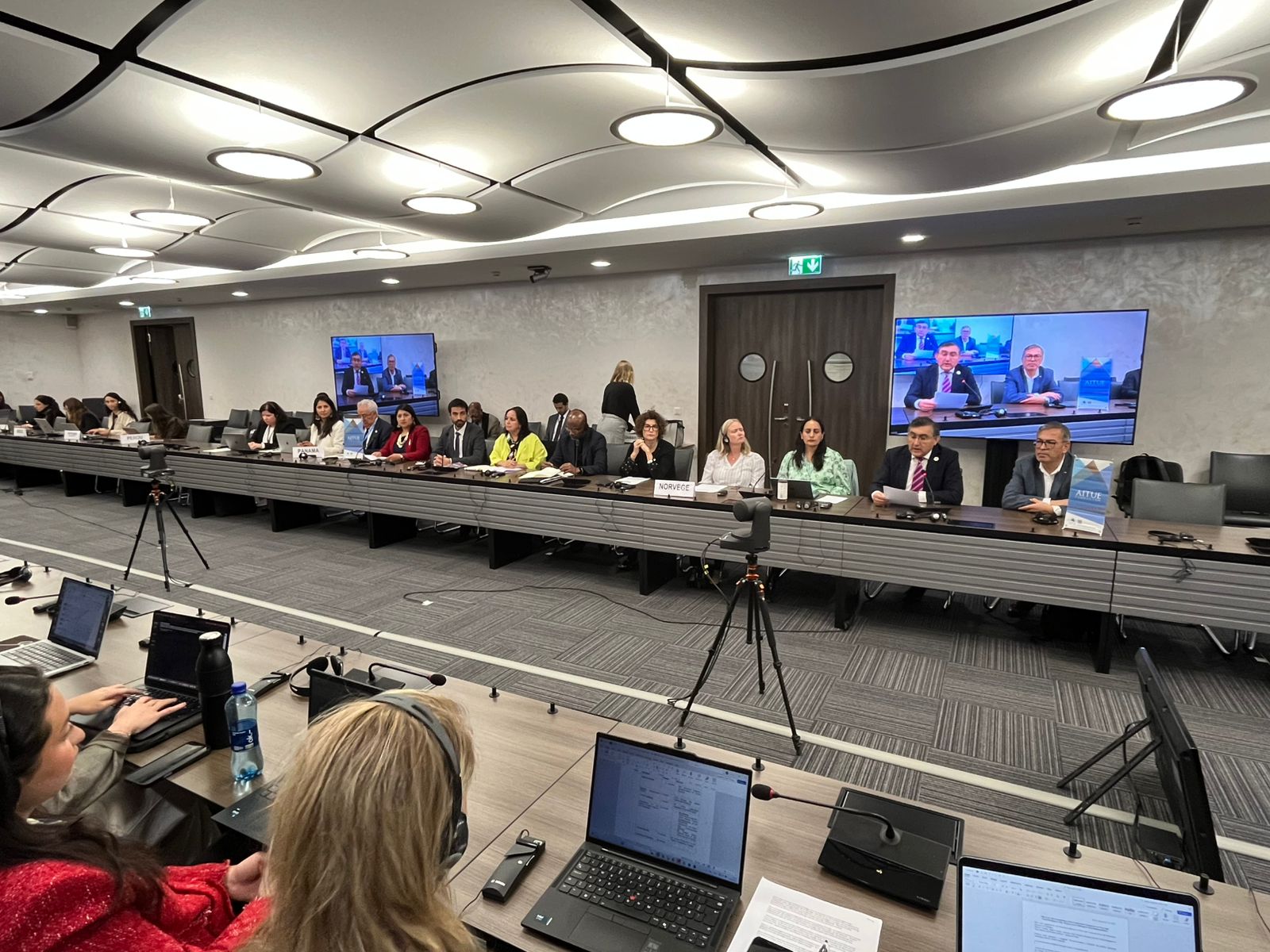
During the 60th session of the United Nations Human Rights Council, Chile presented on September 26th an assessment of the progress and challenges in implementing the 21 recommendations of the Presidential Commission for Peace and Understanding (CPPyE). The meeting, co-sponsored by the Aitue Foundation, aimed to enrich the Chilean process with international experiences and demonstrate compliance with global standards regarding the rights of indigenous peoples.
The event, held at the Palais des Nations, was notable for the participation of high-level international representatives. Dr. Albert Kwokwo Barume, UN Special Rapporteur on the Rights of Indigenous Peoples, commented on and highlighted the work carried out by the commission, as did Manuela Tomei, Assistant Director-General for Governance, Rights and Dialogue of the International Labour Organization (ILO).
The dialogue was opened by Carlos Llancaqueo, President of the Aitue Foundation.
“The creation of the Presidential Commission for Peace and Understanding was a powerful signal in a national context marked by mistrust and long-standing grievances. As a foundation that has worked for years to promote dialogue, we especially value the unique cross-party support for this effort, with backing from all political parties with national representation—an unprecedented event that demonstrated that, even in times of polarization, it is possible to find common ground,” stated Carlos Llancaqueo.
Subsequently, the main presentation on the Chilean case was given by former commissioner and senator Carmen Gloria Aravena, former commissioner Gloria Callupe, and the National Head of the CPPyE Monitoring Unit, Fabián Salas, who detailed the Commission’s work and the roadmap for implementing the proposals.
In her presentation, former commissioner Gloria Callupe emphasized that “since the return to democracy, various governments have made significant efforts to build policies of understanding and reparation with the Indigenous peoples of the State of Chile. This has resulted in the creation of different presidential commissions and bodies that formulated recommendations for adopting regulations or public policies related to Indigenous peoples. Therefore, it was decided to establish the Commission for Peace and Understanding with the objective of creating a forum for dialogue and consensus-building that would allow for the incorporation of recommendations and proposals from the communities and stakeholders involved, in order to build and consolidate a long-term solution to this conflict.”
Regarding the diagnosis and data collection process, Senator Carmen Gloria Aravena stated that “the qualitative and quantitative analysis of historical figures and projections related to land demands in Chile allows us to establish a clear diagnosis and overview of the current situation and the time required to address this problem. The figures reflect the State’s ongoing efforts to acquire land, but they also demonstrate that a significant gap persists between what has been purchased and what is demanded in terms of territorial reparations for the Mapuche people.”
Finally, Fabián Salas, National Head of the Monitoring Unit, concluded that “the Commission for Peace and Understanding has given us a clear roadmap. It is up to us—as a State and as a society—to have the courage to implement it, engaging in dialogue and moving forward together with the communities with respect and cultural sensitivity. The recommendations seek to advance justice and reparations, both for the historical demands of the Mapuche people and for those who have been victims of this conflict, Mapuche and non-Mapuche alike. And, in conjunction with this, to achieve progress in economic development in regions as rich in opportunities and resources as the Biobío, La Araucanía, Los Ríos, and Los Lagos regions.”
The comments from international experts provided support and guidance for the process. The UN Special Rapporteur and the ILO Assistant Director-General commended the progress made and offered technical observations.
“The ILO has had the privilege of providing technical support to this process, offering technical input on the scope and application of Convention 169, ratified by Chile in 2008. This Convention is not only a legal instrument, but also a human rights and peacebuilding tool. In countries such as Guatemala, Nepal, and Colombia, it has been a source of inspiration for important legislative and institutional reforms, as well as an integral part of peace commitments,” said Manuela Tomei, Assistant Director-General for Governance, Rights and Dialogue at the ILO.